


A treasure of art and history
Discover the history and the secrets of the Church of San Vigilio in Pinzolo, visited every year by thousands of art and history enthusiasts.
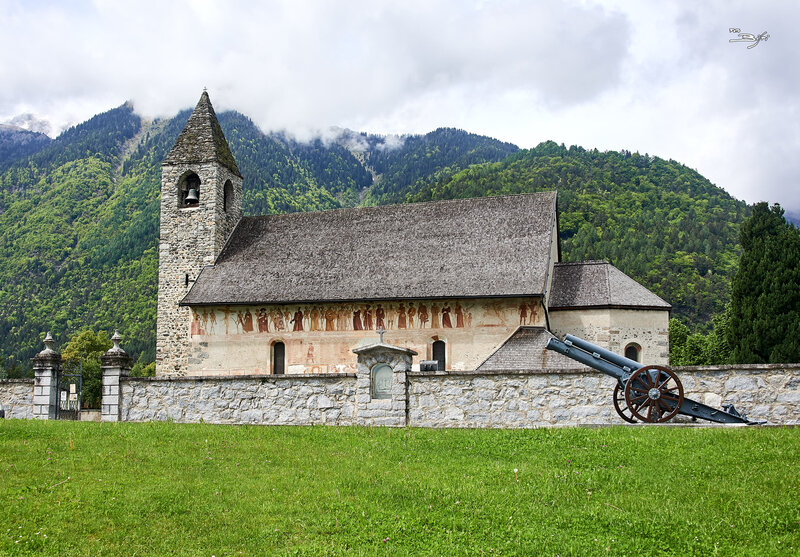
The ancient church tells a tale“L’antica chiesa racconta”: this is the title of the latest book by Giuseppe Ciaghi, a local history expert and deep connoisseur of the genius loci, dedicated to the Chiesa di San Vigilio of Pinzolo. Indeed, the sacred building presents to the observer, whether attentive or casual, a true narrative through images, inviting you to linger on the pictures adorning the exterior and interior of the church. A story animated by figures, cartouches, verses, symbols, and historical references that since the 16th century stands watch over the Val Rendena basin, the ancient territory of Sopracqua, and warns those passing its walls—from Renaissance travelers to today’s tourists.

A universal, timeless message that this great pinzolo fresco repeats each day and that each of us, in these times of such aggressive individualism, would do well to keep in mind.
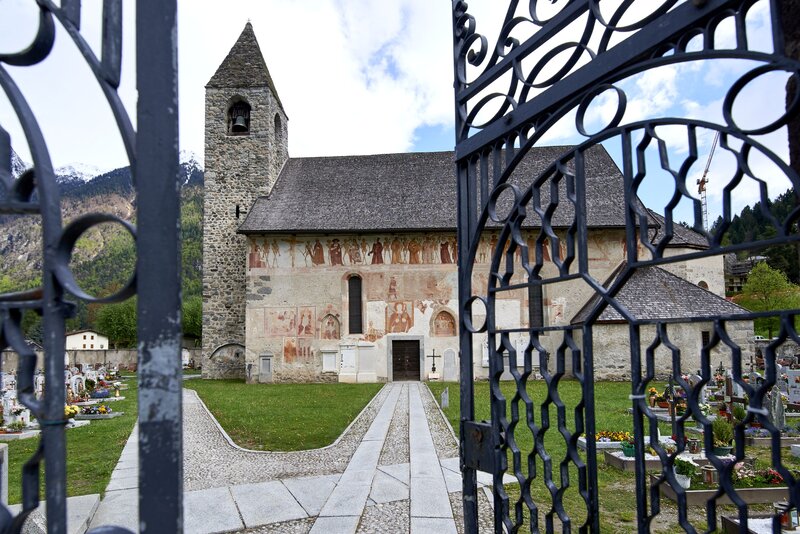
The architecture and frescosTraces of prior construction are still visible within the church, where slabs of granite in the floor indicate the ancient perimeter of the building prior to its expansion in the 16th century. In the same way, the border of the paint on the walls points to the “hut-like” form of the early architecture. The roof, which is made of trusses, finished externally in hand-cut larch-wood shingles and featuring broad pitches, has enabled the external frescoes on the south wall to resist both the elements and the passing of time. Although the wall has frescoes from the base on up to under the roof and the remnants of frescoes from prior to the 16th century remain visible, despite having faded or been partially covered, the series of works that dominates the space to this day, and which has made the church famous, is that of the Danse Macabre, the “Dance of Death”.
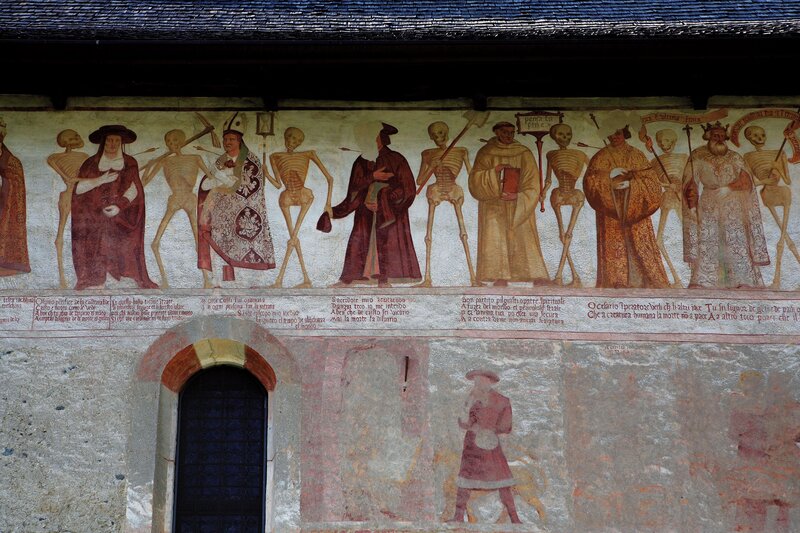
LA DANSE MACABRECommon to northern and central Europe, the Danse Macabre harkens back to the sense of fear and turmoil that marked medieval times and the Renaissance and, at the same time, to the need for equality, justice and freedom, at least in death, that the poorest segments of the population could lay claim to over the well-to-do, dominant classes. The series of frescoes is attributed to Simone Baschenis of Averaria, member of the Baschenis family of fresco artists from the Lombardy region, who brought their art out into the Lombard alps and to the valleys of the Trentino region. These traveling artists offered their services to the local mountain communities, creating paintings that were easy for the locals to understand. The most famous of the family artists was, in fact, Simone, who decorated numerous sacred buildings in Val Rendena and the Giudicarie and made his mark with the Danse Macabre on the churches of San Vigilio in Pinzolo and Santo Stefano in Carisolo. Simone’s style evokes the atmosphere of the late medieval era, but with a decisive nod to the conquests of the Renaissance in terms of proportions, his use of color, and the strength of the figures - artistic elements that, while nearly relegated to the background in the Danse Macabre by the solemnity of the theme, are absolutely evident in the series at San Vigilio and in the splendid figure of St. John the Baptist (on the north wall behind the altar dedicated to Saint Roch).
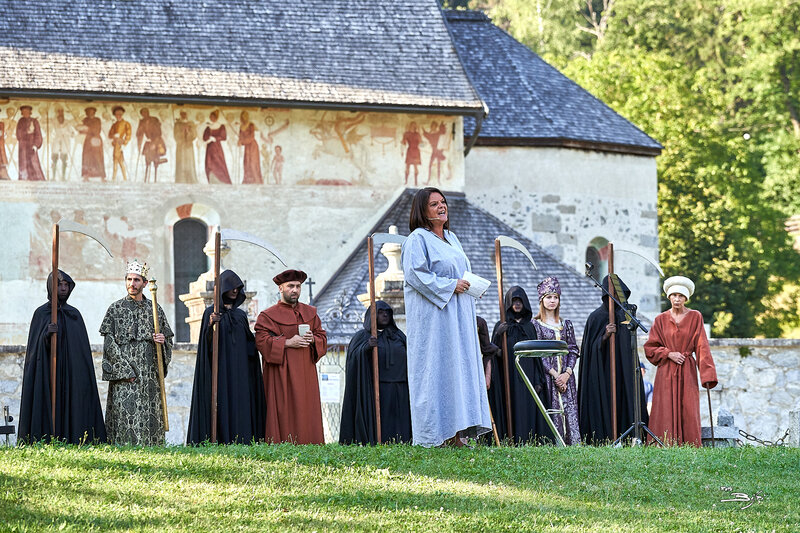
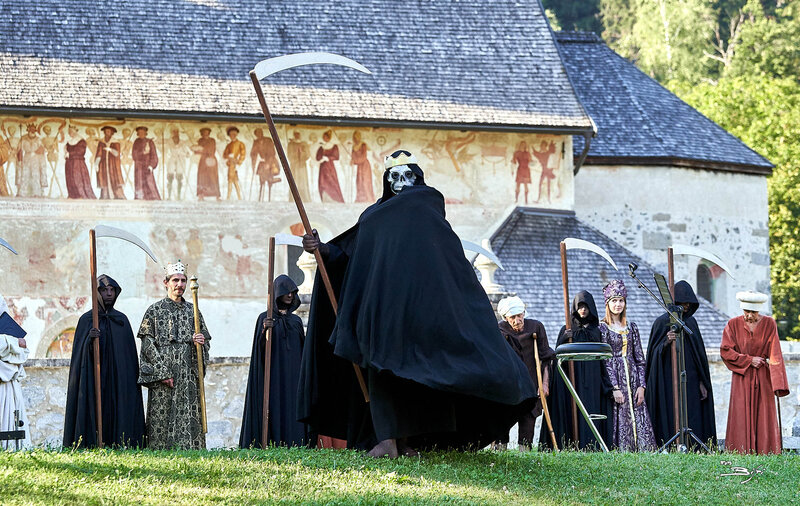
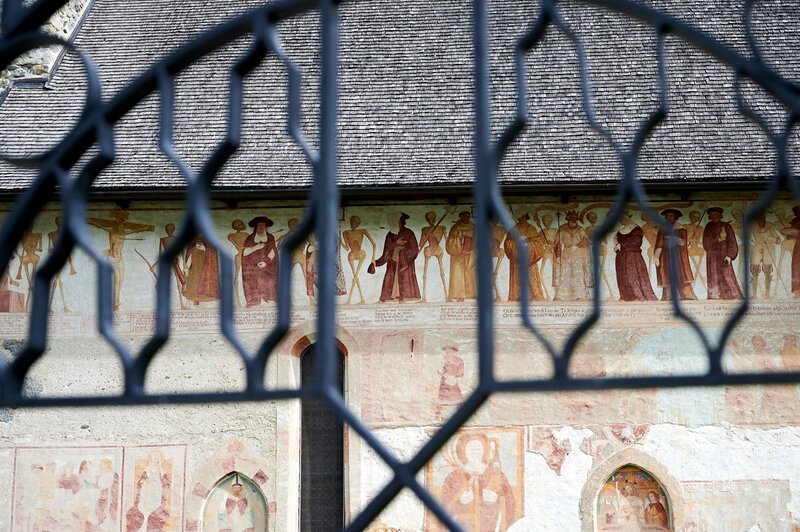
The Dance of DeathIn life, one may be the Pope, a prince, or a mere farmer; none of that matters once we reach that final moment. Death is the commander, the great equalizer. As the ancient verse beneath the fresco states. It is with these lines that the dance begins, with Death presenting himself to the world, to the onlookers and, above all, to the dancers themselves, who will be forced to dance with him, because not even the Son of God, as we see in the first image—the Crucifixion—was spared from the fate of each and every one of us. None of us can hope for a different fate; the skeletons take us all, from all walks of life, by the hand and lead us to our inescapable end as we dance with them to music which is also being performed by an orchestra of skeletons. Thus we see, throughout the 22 meters of the series, the pope, the cardinal, the bishop, the priest, the friar. First the church, each of its representatives adorned in the trappings typical of their rank and role—richly embroidered and colorful for the highest ranks, simpler and more monochrome for the rest, but all depicted in ample drapery to convey the physicality of the characters. These are then followed by the laypeople, also shown in clothing that points to their social position. There is the emperor, the king, the queen, the duke, the doctor, the soldier, the miser, the knight, an invalid. The women, then, make up the final grouping and include the abbess and a beautiful woman, immediately followed by an elderly woman. Each of these figures is stricken by the arrow of death, indicating their imminent passing, and are led by their skeletal dancing partners. Those that accompany the highest ranks of both the clerical and non-clerical classes show an air of derision and scorn, while the skeletons with the poorer people seem almost supportive and compassionate and are painted with lighter, almost transparent strokes to indicate that, for these people, death is not a burden, but rather something of a liberation from life’s trials and tribulations. The final figure in the court is the child and is the only one not to have been stricken by the arrow of death. The child has been granted more time to grow, to live, and to show his own temperament prior to his day of judgment, when he will be led either to Heaven or to Hell—as is happening with all the souls from the previous scene—where St. Michael or Satan will assign them to their eternal fate.


